Review Policy
The Perspectivas Journal applies a peer review process aimed at ensuring the scientific quality, relevance, originality, rigor, and integrity of the published works.
The editorial process is conducted according to the principles of editorial independence, impartiality, confidentiality, transparency, and scientific integrity.
All submitted manuscripts initially undergo a preliminary editorial assessment before being sent for peer review. At this stage, the following aspects are verified:
- Alignment with the journal's focus, scope, and thematic areas.
- Compliance with the instructions for authors and formal requirements.
- Submission of the elements necessary for scientific evaluation.
- Apparent originality and, where applicable, the results obtained from similarity detection tools.
- Compliance with applicable ethical and editorial requirements.
When remediable formal deficiencies are identified, the manuscript may be returned to the author for correction before proceeding with the editorial process. Compliance with formal requirements does not imply acceptance or guarantee that the manuscript will be sent for peer review.
The Perspectivas Journal uses a double-blind peer review system. The identities of the authors are not disclosed to the reviewers, and the identities of the reviewers are not disclosed to the authors during the evaluation process.
Each manuscript is evaluated by at least two external and independent reviewers, selected according to their academic background, experience, and expertise in the subject area of the manuscript. When necessary, the journal may appoint external ad hoc reviewers with specialized knowledge.
Reviewers must declare any actual, potential, or perceived conflict of interest that may affect their objectivity. When a situation compromises the independence of the evaluation, the responsible editor will appoint an alternative reviewer.
The journal seeks to maintain a broad and diverse reviewer community, avoiding institutional concentration and promoting the independence of the peer review process.
Manuscripts submitted for review are confidential documents. Reviewers may not share, reproduce, use, or disclose their content prior to publication, unless expressly authorized by the editor.
Reviews must be objective, respectful, constructive, and well-founded, taking into consideration, according to the type of contribution:
- Originality and contribution to knowledge.
- Relevance and significance of the work.
- Clarity of the objectives.
- Soundness and appropriateness of the methodology.
- Rigor of the analysis and consistency of the results.
- Quality of the discussion and conclusions.
- Relevance and currency of the references.
- Clarity of the structure and presentation.
- Compliance with principles of research ethics and integrity.
Reviewers will have a maximum of 30 calendar days to submit their review report. When a reviewer is unable to complete the evaluation within the established period, the editor may authorize a reasonable extension or appoint a new reviewer.
Reviewers provide scientific reports and recommendations, but do not make the final editorial decision. This decision rests with the Editor-in-Chief or the responsible editor, who considers the reviewers' reports together with the applicable scientific, editorial, and ethical criteria.
As a result of the evaluation process, the manuscript may receive one of the following decisions:
- Acceptance: the manuscript may proceed to editorial production.
- Minor revisions: revisions are requested that do not necessarily require a new full scientific evaluation.
- Revision and re-evaluation: substantial revisions are required, and the manuscript may be submitted to a new round of peer review.
- Rejection: the manuscript does not meet the conditions required for publication.
When there is a substantial discrepancy between the reviewers' recommendations, the editor may request an evaluation by a third independent reviewer. The final decision will remain the responsibility of the editor.
When revisions are requested, authors must submit a new version of the manuscript and, where applicable, a response to the reviewers' comments.
Depending on the nature of the revisions, the editor may request a new evaluation by the original reviewers, by new reviewers, or conduct an editorial assessment. Submission of a revised version does not guarantee acceptance.
Once accepted, the manuscript proceeds to editorial production, which may include copyediting, formatting review, verification of references and metadata, typesetting, and other necessary editorial controls.
Once these processes have been completed and the final version has been approved, the article will be published and disseminated through the journal's channels. Where applicable, published articles will include the dates of submission, acceptance, and publication.
The peer review and publication process for manuscripts submitted to the Perspectivas Journal follows the workflow below:
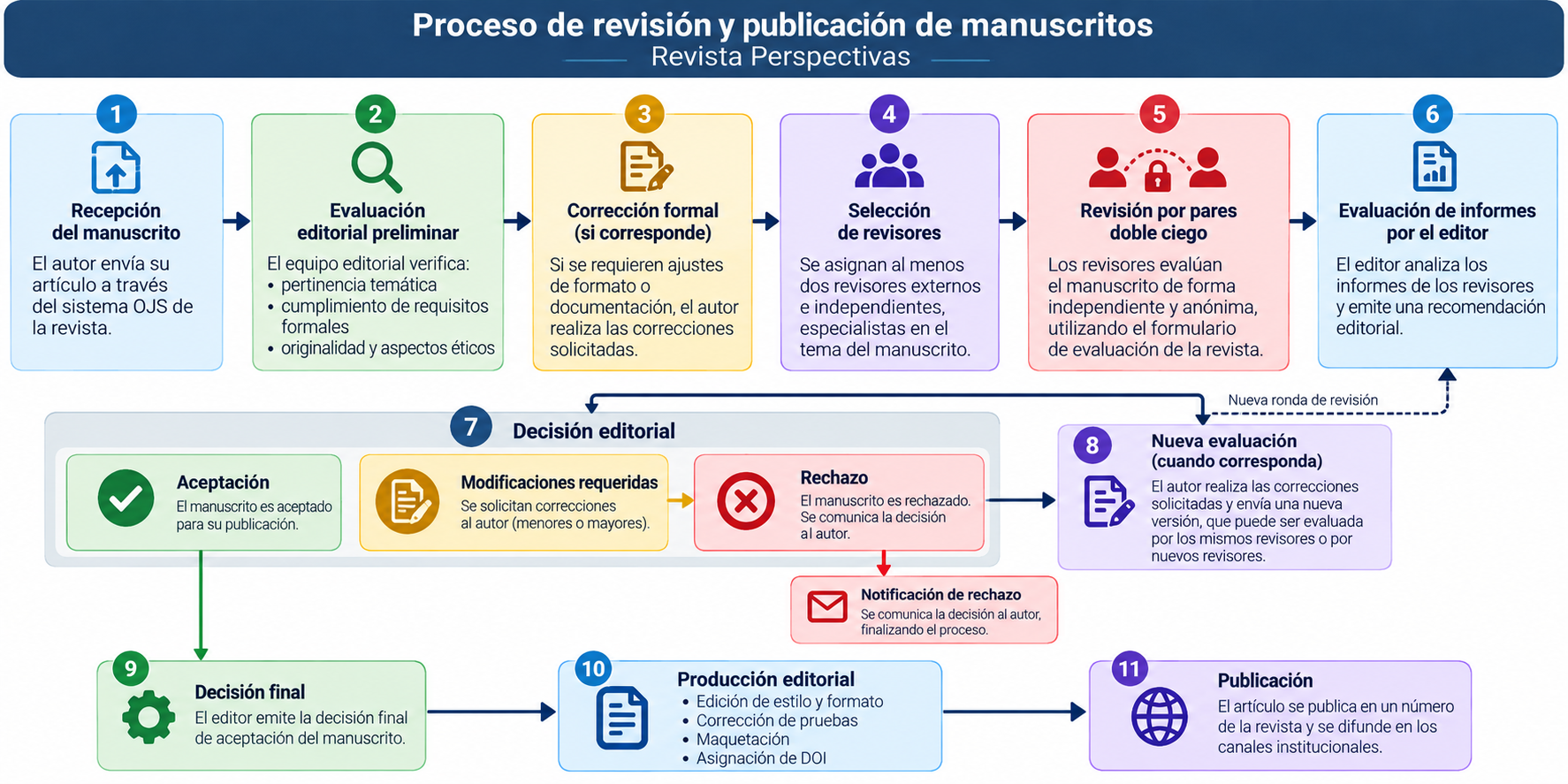
Peer review and publication process of Perspectivas Journal.